


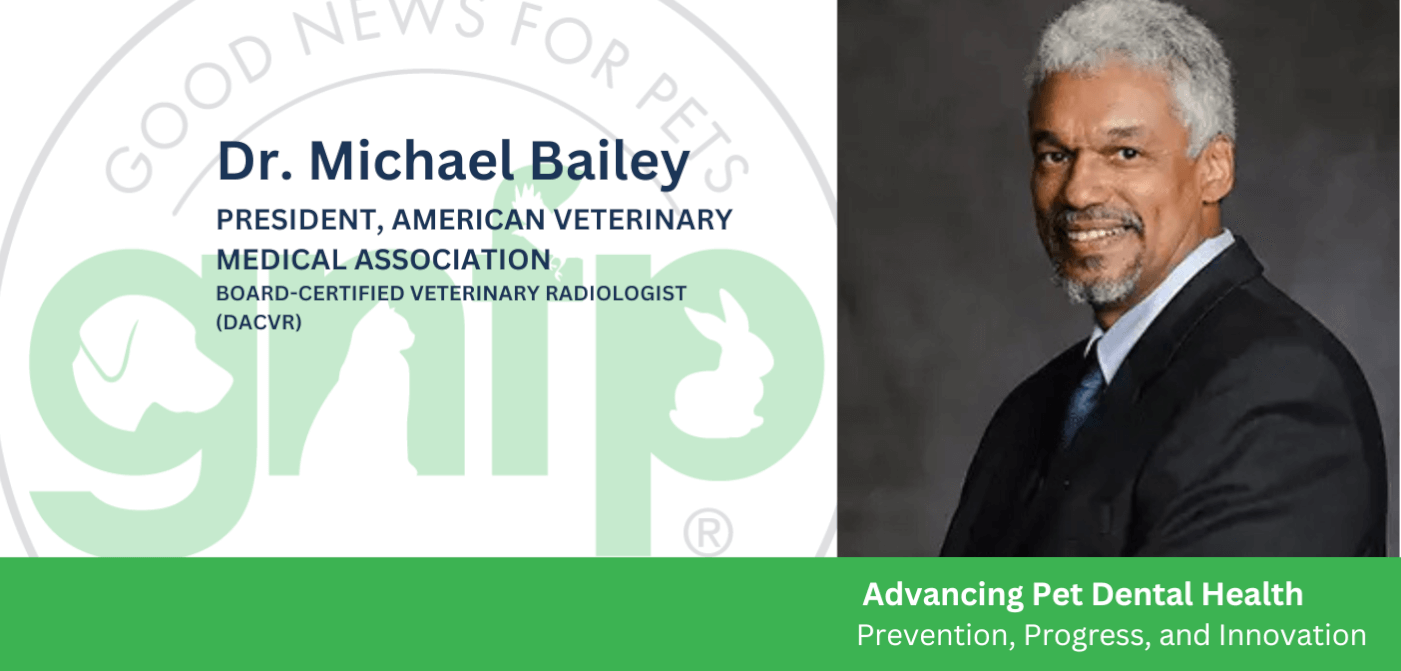
AVMA President Dr. Bailey on AI in Veterinary Dentistry, Pet Dental Awareness & More
Editor’s Note: I had the great pleasure of interviewing Dr. Michael Bailey, president of the American Veterinary Medical Association, for Pet Dental Health Month. We talked about AI in veterinary dentistry, the difference between dog and cat dental disease signs and prevention, and about other pets, including horses. The bottom line, as Dr. Bailey notes, is that the AVMA raises awareness of pet dental care in February, but veterinary dental care is an important part of our beloved pets’ health every month to prevent not only dental disease but also other diseases. Thank you, Dr. Bailey! – Lea-Ann Germinder
How is Artificial Intelligence being used in veterinary dentistry?
AI in dentistry is just as vital as any other healthcare field, and the biggest thing is that it will improve diagnosis. I’m saying that because it’s really just coming into it. It will improve patient care due to improved diagnosis.
It also will improve access to care because the dental radiographs or dental images, because not just radiographs can be not just analyzed by the AI, but then they’ll be able to be transmitted to another specialist if necessary for a second opinion without the pet and the pet family having to travel that distance.
It goes beyond that because AI can also help with treatment, including precision treatment for the patient. What is right for one patient may not be right for another patient for various reasons.
For example, just think about antibiotic sensitivity. AI can analyze everything about the patient. A veterinarian may say, ” Well, I’m going to use this antibiotic, and the AI says this patient shows sensitivity to that antibiotic. So, for that and other various reasons, the veterinarian decides not to use it. That’s just one very simple example, but there are other broader implications.
One of the things you talk about in the general discussion about dentistry is the use of anesthesia. Some pet owners are concerned about that. Could AI reduce the time required for anesthesia?
It will reduce the amount of time for anesthesia. What I’m about to say is futuristic. It’s not here today. It may even reduce the need for anesthesia because AI will be able to identify situations where we currently need anesthesia, but I’m saying that’s futuristic.
Is there another benefit to the use of AI in veterinary dentistry?
Yes. AI can actually be predictive. It may say, it looks like there’s an extra tooth coming in here so we can plan. That’s one of the things I see AI being able to do. Any medical care has a cost associated with it, but if you can now plan on the expenses that may be associated with dental care for your pet.
Human dentists are using AI too, but there is a concern that AI could be used as the gold standard or is it the human being?
The human is the gold standard. Always keep a human in the loop. You cannot use AI without human involvement. People talk about the gold standard. The gold standard is where, if you could fly to the moon to get something, that’s where you’d love to go, but most people are going to stay inside the atmosphere. We should talk about what is out there, maybe beyond reach, but then what is it that is within reach, and how we can maximize that. We’re talking about the standard of care. AI will raise the standard of care because AI and what it offers will be available to more people.

The AVMA raises public awareness about many pet health issues. Why does AVMA focus on Pet Dental Health Month and dental care for a whole month in February?
I like to call it dental awareness month, because dental health should be 12 months out of the year. We do try to remind people in February now about why dental health is important. I’ll give vaccines as an example. Vaccinations have done more to improve the health of people and animals and have added to life expectancy. If we have a good vaccine regime, we have probably done as much as we can with vaccination, emphasizing the quality of health.
Dental is the next frontier. Here’s the reason people don’t think about it. They look at the teeth superficially and they say, ‘those teeth look great’. They cannot see what’s happening below the gums unless you’re superman or superwoman or super dog. They can see what’s happening above the gums, but most of us do not have X-ray vision.
The large majority of the disease occurs below the gums. We need people to be aware that we need to find out what’s happening below the gumline and treat it. Here’s the reason why. A lot of the chronic diseases that our pets and people are having today are probably the result of dental disease.
If we can reduce dental disease, we can likely delay the onset of that chronic health condition. Heart disease, renal disease, liver disease, and cancer are four diseases that we can trace that have a high association with dental disease. This is because dental disease is an inflammatory process. Inflammation causes changes throughout the body, and those are the organs it predominantly affects. If we can reduce that inflammation, fewer organs will be affected.
There is a statistic that 80% of dogs and 70% of cats have oral disease by the age of three. Can you talk about that?
I truly wonder whether 70% of cats is low, because cats are more difficult to do even an awake dental exam. Just look at their teeth. There’s probably a higher percentage of cats that have even had a visual exam. But the reason why we are trying to make individuals aware that there’s this dental disease, and the predominant disease we’re talking about is periodontal disease, and that’s the one predominantly below the gums.
As an example, a cavity, a cracked tooth, a missing tooth, or an excess tooth, you might be able to see that. But the majority of your dental disease is periodontal disease. That’s the inflammation we’re talking about. I think there’s probably even more of it, and sooner than we are talking about.
Why is the use of anesthesia the key to a safe and effective veterinary dental cleaning?
There are several reasons, but it’s very easy to think about the fact that when you have a dentist poking around in your mouth, how much do you like it? Our dogs and cats, for the most part, do not have human-understandable words. Notice I said human understandable words. The one word that we do understand is a bite. We cause them discomfort, and they respond with their language.
We cause them discomfort, and they respond in a very negative way because they’re trying to say, ” You’re negative to me, I’m negative to you. But then there’s even more. If we’re poking around with those teeth and let’s say it’s a perfectly healthy tooth and we have a tool in there and they move all of a sudden and now they now have a cracked tooth or even a crown that’s been wrenched off, or let’s say we do have a patient who we identify has some degree of disease and we’re trying to get into those pockets. It may be a tooth that can be saved if you do the proper things.
There are actually wonderful new tools out there that can save teeth with some of the diseases we’re talking about, even in relatively advanced cases. But if you have a tool in there and that tooth is weak and its periodontal attachment is weak, it doesn’t take much to pop it out. We don’t want to do that if we don’t have to. We can be dangerous to the organs that we’re talking about, and the teeth are organs. It would be sort of like you have a scalpel blade up against your abdomen, and somebody moves, and now that scalpel blade is sitting inside the liver.
Does scraping the teeth and forgoing anesthesia work?
For the most part, if you’re scraping the teeth, which we have in human medicine too, it’s descaling. We have the same thing done to our teeth. However, you notice that after they finish descaling, they come back and polish the teeth really well. That’s because the descaling leaves little grooves in the teeth.
If you don’t polish the teeth really well and try to eliminate those small grooves, that’s where bacteria lodge. You cannot do a thorough cleaning. If it’s something you are concerned about, my recommendation is to start brushing your dog’s and cat’s teeth early on. That can be done to reduce tartar buildup and other issues, but at a minimum, you should go to your veterinarian and have a visual exam of the teeth on a regular basis.
If you brush your teeth once a day, that’s great. Once a week works, even once a month can be useful for brushing the teeth. If you really want to decrease the cost of dental care and increase your pet’s health, I would recommend brushing your pet’s teeth.
First thing is getting them used to the fact that you’re going to have something in their mouth on a regular basis. That’s the first thing. You ideally do that when they’re young so that it becomes a game, hopefully. We’re starting to have data on patients who do have regular oral hygiene, and how it takes longer for dental disease to develop, just like in people.
There are obviously lots of products out there that claim to clean or scrub the dog’s teeth. What’s the significance of those claims? How does a pet owner know what to believe?
Go to your veterinarian. I want to emphasize it’s not passing it off. Your veterinarian knows your pet, and one may be better than another for your pet, and they’re going to help you. You can do the best thing for your pet. Check the AVMA website at @avma.org to see what we have there. This is one of those things where your veterinarian and the veterinary healthcare team are really your best resource. They want to help you so you do not need an extraction.
What are the signs a pet owner should look for that their pet has dental disease?
It starts off with, “Does the breath stink?” That’s probably the first thing people notice, but that’s probably not the first thing that happens. Bad breath, the pet having difficulty eating, even the fact that you go near their mouth, and they become defensive, especially when it wasn’t a pet that was guarding their mouth previously. If you see any of those things where they’re just not acting normally.
Another sign is that they used to love chewing on a particular toy, but now they no longer play with it. You go out and buy them a new one, and they just look at it and go on. Why? Because to chew on it may hurt. Look for any signs of oral pain, but I hope we can make it so that they never develop that oral pain.
If they love drinking water with ice in it, notice I didn’t say “giving them ice cubes,” because with some pets, ice cubes aren’t the best thing, but you may have had water where you put ice in the summer to help cool things down. They may shy away from it until those ice cubes are all melted away. You say, Hmm, that’s not Fido’s typical reaction to this.
Are these signs different for cats versus dogs?
Yes, cats may not show the same signs, but you’re going to see changes in their eating behavior that will affect their breath. It does take a lot more for a cat’s breath to become bad. If their breath gets really bad, I will definitely take them to the veterinarian for an examination. But once again, we don’t want to get that far. We want to get it so you’re catching things before they reach that point.
What about pets other than cats and dogs? Do other pets get dental disease, and if so, how are they treated?
I’m not going to tell you to check the teeth of a poisonous snake, that’s for sure, but any animal that has teeth is going to have the potential of dental disease. We have some animals that are constantly growing out their teeth. If you are talking about rabbits and rats, for example, their teeth are always growing. They need to have different kinds of attention of their teeth.
If you have a pet with teeth, they probably need regular attention. It may not be the kind of dental disease we’re talking about in dogs and cats, but you don’t need to have those teeth growing long and digging into themselves. Sometimes even those tusks we see are actually teeth, but genetically they grow out.
Horses are another good example. They do need to have regular dental care. There you are, looking for sharp spots on their teeth, and they have to file them down. If your pet has teeth, take care of their teeth.
How does the AVMA help the veterinarian convey to the pet owner the importance of dental health?
We talk to media like you, and we also try to make sure that people have an opportunity to learn, to make it fun, and do it in fun environments. As an example, we may go out to a pet health fair and talk to kids.
Our main message is we try to let individuals know that if we can do dental healthcare a pet’s entire life, we are going to reduce the cost of veterinary dental healthcare for the pet. The thing which people have to remember is that dental healthcare is not something that if I do this today, tomorrow I’m going to see a saving. No. If you do it today, 10, 15 years down the road, you’re going to see savings. And if you notice, I said 15 because that pet who might’ve had a 10 or a 12-year lifespan, we’re trying to give them a 15- or 17-year lifespan.
What is the typical cost of a dental cleaning, and where should a pet owner put dental care in terms of prioritization of the overall health of their pet?
It depends on what part of the country and even what city you’re in a particular state as to what it costs. But just think that the average visit to a veterinarian today costs $200, and dental healthcare is going to cost you somewhere around that range, maybe a bit higher, adding in the anesthesia. But by comparison, cancer treatment for your pet can cost you thousands of dollars. A few hundred dollars upfront to reduce those thousands of dollars later on, that’s a pretty good bargain. But what we are primarily talking about is maintaining your pet’s quality of life so they never experience that pain. They can come and roll up on your lap if they want to because they don’t have bad breath. They’re going to have better nutrition because they’re going to eat their diet, whether it’s kibble or whether it’s fresh food, they’re going to be eating that diet. Hopefully, we can reduce some of the chronic diseases pets get as they age.
Is there anything else you would like to add?
We raise awareness every February that dental care is available year-round. If you want to set your calendar to make sure your pet has a dental appointment every February, that’s fine, but I’d say set it for whatever month is good. Set it for your birthday or your pet’s birthday, but make sure dental healthcare is on your list. It’s part of the overall preventive health plan. It’s going to save your pet from discomfort, whatever that discomfort may be. And that’s what we want in the long run. We want everybody, including our pets, to be healthy and happy.